

Intro #
The IP2Proxy database provides comprehensive and up-to-date intelligence on IP addresses that are associated with proxy usage. By identifying whether an IP address is operating as a proxy, it enables businesses and developers to better understand the nature of incoming traffic and make more informed decisions. This is especially important in today’s digital landscape, where anonymous connections and masked identities are commonly used for both legitimate purposes and malicious activities such as fraud, scraping, and bot attacks.
Updated on a daily basis, the IP2Proxy database not only flags proxy IP addresses but also classifies them according to the specific type of proxy server they represent. This added layer of detail allows organizations to differentiate between various proxy categories such as data center proxies, residential proxies, VPNs, Tor nodes, and more, each with its own characteristics, risk levels, and typical use cases.
VPN #
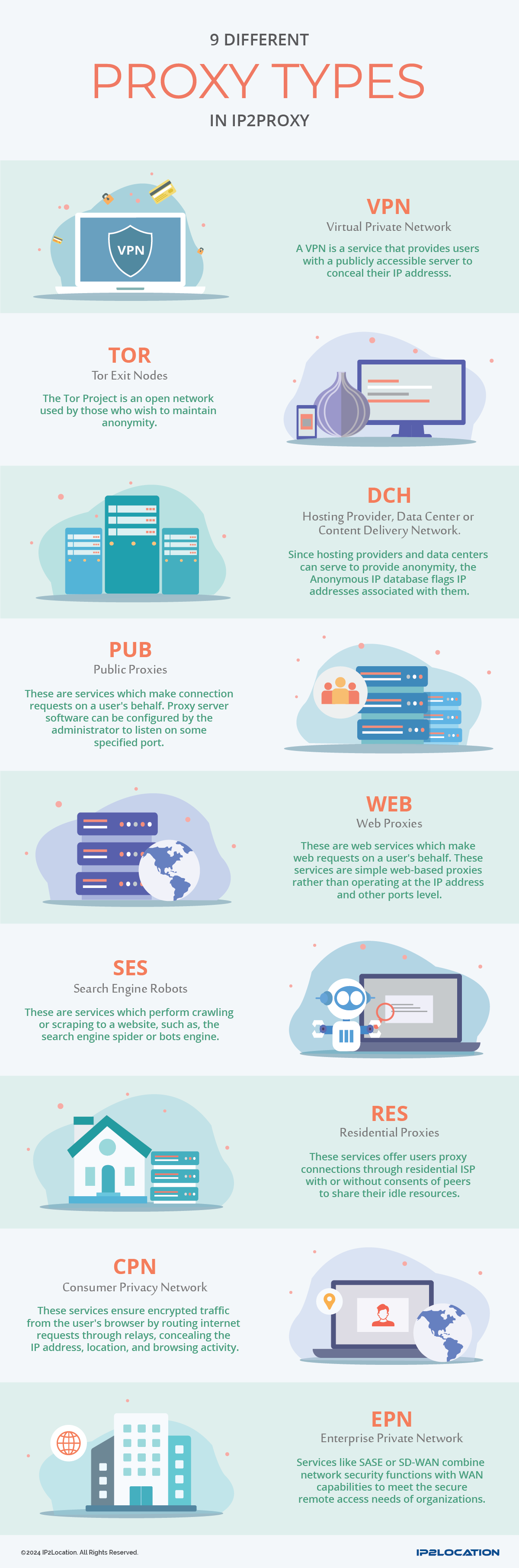
Virtual Private Network. A Virtual Private Network (VPN) is a service that provides users with a publicly accessible server to conceal their IP address.
TOR #
Tor Exit Nodes. The Tor Project is an open network used by those who wish to maintain anonymity.
DCH #
Hosting Provider, Data Center or Content Delivery Network. Since hosting providers and data centers can serve to provide anonymity, the Anonymous IP database flags IP addresses associated with them.
PUB #
Public Proxies. These are services which make connection requests on a user’s behalf. Proxy server software can be configured by the administrator to listen on some specified port. These differ from VPNs in that the proxies usually have limited functions compare to VPNs.
WEB #
Web Proxies. These are web services which make web requests on a user’s behalf. These differ from VPNs or Public Proxies in that they are simple web-based proxies rather than operating at the IP address and other ports level.
SES #
Search Engine Robots. These are services which perform crawling or scraping to a website, such as, the search engine spider or bots engine.
RES #
Residential proxies. These services offer users proxy connections through residential ISP with or without consents of peers to share their idle resources.
CPN #
Consumer Privacy Network: These services ensure encrypted traffic from the user’s browser by routing internet requests through relays, concealing the IP address, location, and browsing activity.
EPN #
Enterprise Private Network: Services like SASE or SD-WAN combine network security functions with wide-area networking (WAN) capabilities to meet the secure remote access needs of organizations.


