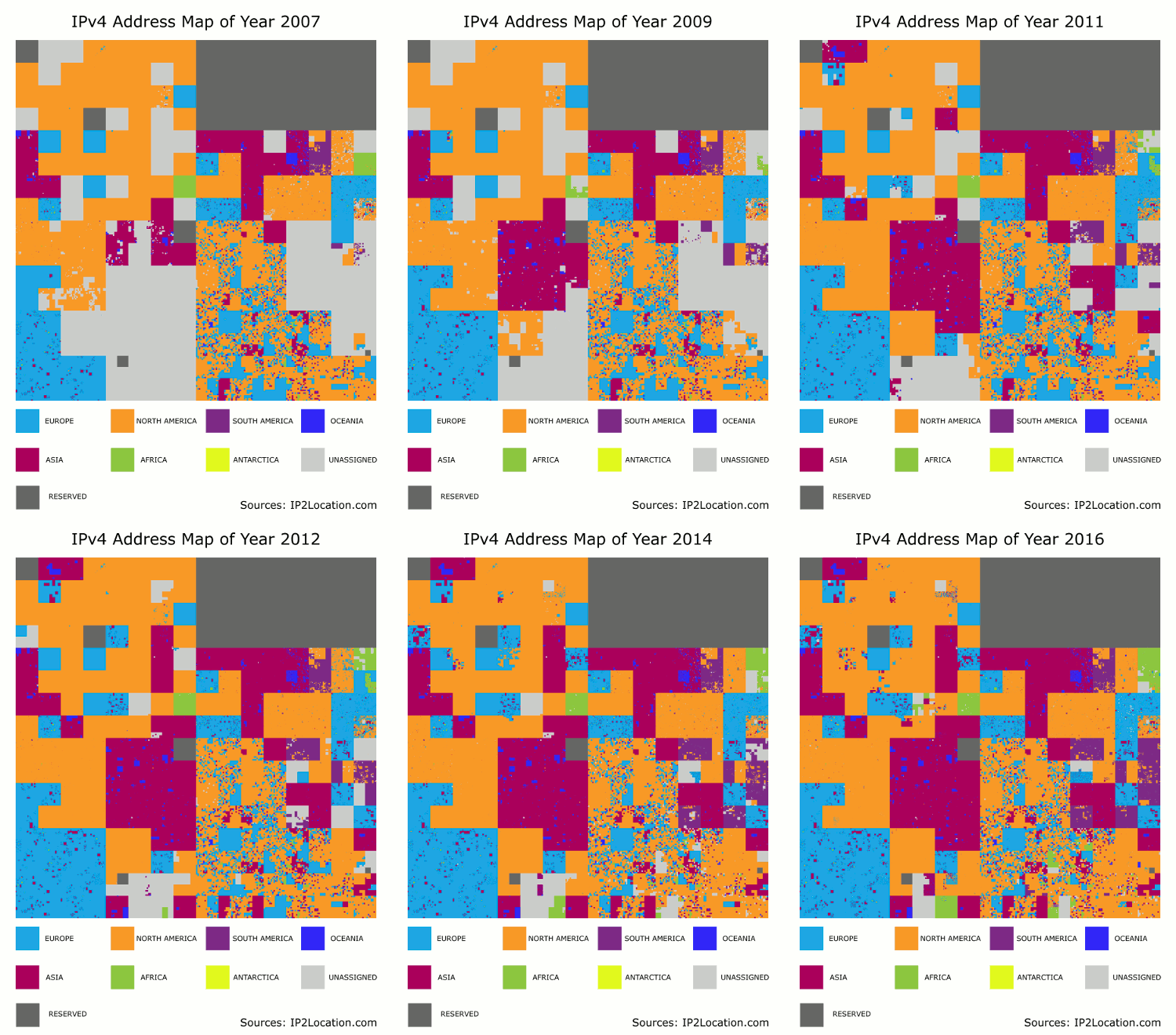

This article presents a comprehensive empirical study tracking the allocation and utilization of Internet Protocol (IP) addresses across all seven continents over a ten-year horizon. Utilizing historical data extracted from the IP2Location core database spanning 2007 through 2016, this analysis details the macro-level shifts in global network distribution. The following sections explore critical architectural and administrative milestones of the internet ecosystem, specifically focusing on the IPv4 classful addressing architecture, Regional Internet Registry (RIR) distributions, structural assignment methodologies, and the eventual exhaustion of the unallocated IPv4 pool.
Foundational Overview of IP Architecture and the Classful Scheme #
Internet Protocol version 4 (IPv4) utilizes a 32-bit logical addressing architecture. In theory, this 32-bit constraint yields a maximum theoretical address space of 4,294,967,296 unique host interface destinations. To make these binary identifiers human-readable, network engineers express the 4-byte architecture using dotted-decimal notation. This convention separates each individual byte into a decimal value ranging from 0 to 255, isolated by periods, as demonstrated by standard routing addresses like 192.168.1.1.
Every IPv4 address contains two distinct logical segments: the network prefix and the host identifier. The network portion defines the specific routing domain to which a device connects, meaning that all interface cards attached to the same physical or logical network share an identical network prefix.
Historically, the boundary line between the network prefix and the host identifier shifted depending on the designated class of the address space. The legacy classful addressing scheme partitioned the entire global IPv4 footprint into five distinct structural classes: Class A, Class B, Class C, Class D, and Class E. Core routing hardware determines the class of any given address block instantly by evaluating the leading bits of the first octet.
The Decentralization of IP Governance: Regional Internet Registries (RIRs) #
Historically, the Internet Assigned Numbers Authority (IANA) managed the entire global IPv4 address pool directly. Operating as a core administrative body, IANA oversaw all numbering assignments from a centralized framework. However, as internet infrastructure expanded exponentially in the early 1990s, this centralized model faced scalability challenges.
In 1992, the Internet Engineering Task Force (IETF) published structural recommendations advocating for a decentralized governance model. The IETF proposed shifting number resource management to specialized, regional subsidiary organizations. This initiative led to the establishment of the Regional Internet Registry (RIR) system, partitioning the globe into distinct administrative territories to manage IP address allocations more efficiently.
The map above illustrates how the international community divides global IP administration. Today, five distinct RIRs coordinate numbering resources across specific continental boundaries:
- AFRINIC (African Network Information Centre): Manages IP address allocations and network numbering resources across the entire African continent.
- APNIC (Asia Pacific Network Information Centre): Oversees internet registry operations, training, and number assignments for the Asia-Pacific region.
- ARIN (American Registry for Internet Numbers): Administers core network numbers and IP allocations for Canada, the United States, and several Caribbean islands.
- LACNIC (Latin American and Caribbean Internet Addresses Registry): Governs IP resource distribution and registration for Latin America and the Caribbean basin.
- RIPE NCC (RIPE Network Coordination Centre): Directs allocation activities and connectivity governance for Europe, the Middle East, and parts of Central Asia.
By shifting administrative power from a single central entity to these five regional authorities, the internet ecosystem gained a scalable, community-driven framework capable of managing regional growth and local network requirements efficiently.
Hilbert Curve Mapping #
We use a Hilbert curve to map and visualize the topology of IP address allocation across continents. In simple terms, the Hilbert curve forms a continuous fractal that fills a 2D space while preserving locality, which makes it ideal for visualizing relationships between nearby IP ranges.
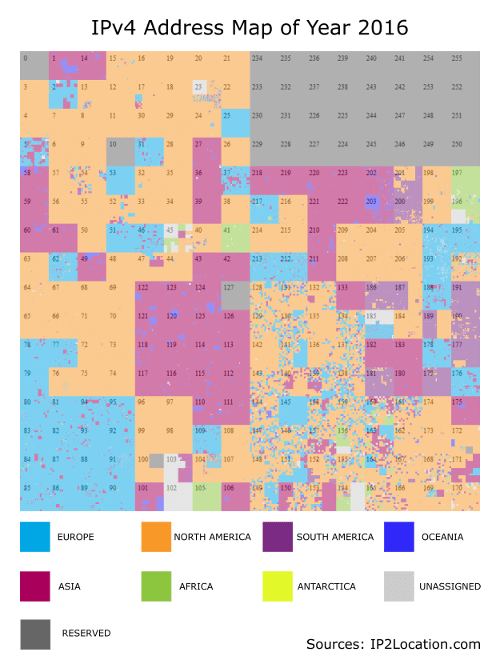
The Hilbert curve map uses a square layout because it represents a matrix sized in powers of two. It maps the full IPv4 address space, from 0.0.0.0 to 255.255.255.255—into 256 blocks arranged in a 16 × 16 grid. Each block represents a range of IP addresses based on the first octet, grouping similar address spaces together for easier visual interpretation.
Unlike a normal grid, the blocks do not follow a simple left-to-right or top-to-bottom order. The fractal nature of the Hilbert curve determines the sequence instead. As a result, adjacent blocks in the visualization may not appear next to each other in a linear row or column, even though they remain close in the underlying Hilbert ordering. To help interpretation, we overlay a trace that shows how the curve moves through the grid.
For example, position [0,0] represents the 0.x.x.x range, followed by [0,1] which maps to 1.x.x.x, and then [0,2] which corresponds to 14.x.x.x. This ordering may seem non-intuitive at first because the curve prioritizes spatial continuity over linear sequencing. The navigation pattern below illustrates how the Hilbert curve fills the grid step by step.

Chart 1: Hilbert Curve
We group geolocation data into seven continents: North America, South America, Europe, Africa, Asia, Oceania, and Antarctica. We also include two additional categories: Unassigned and Reserved IP addresses.
The Unassigned group contains IP addresses that have not been allocated at the time we compile the dataset. These ranges remain available for future assignment and may not yet map to any specific organization or region.
The Reserved IP group includes address ranges that the Internet Engineering Task Force (IETF) has reserved for special purposes, such as private networks, testing, or future protocol use.
By separating these categories, we maintain a clearer and more accurate view of global IP distribution and ensure that unallocated or special-use addresses do not distort geographic analysis.
IPv4 Address Exhaustion #
IPv4 address exhaustion is the depletion of the pool of unallocated IPv4 addresses. At the time of writing, all RIRs except AFRINIC have declared the exhaustion of IP address pool within their registries.
In the 2016 map, we observed some unassigned IP address ranges, but it could be due to reservation by RIRs for future use such as for IPv6 transition. The only class A which is still available is 102.0.0.0/8 managed by AFRINIC.
Explosive Growth in Asia #
Based on the maps from 2007-2012 and Table 1, we have observed a significant increase in the number of IP addresses assigned in Asia by APNIC. In recent years, this trend has decreased due to the exhaustion of the IP address pool.
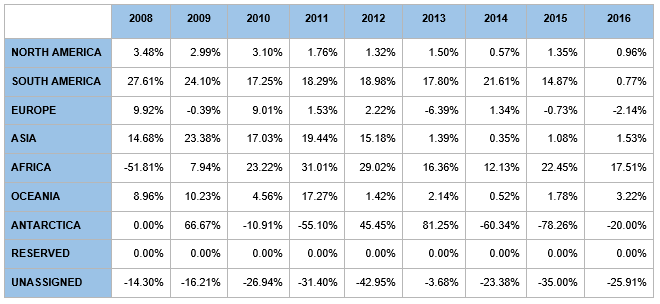
However, we also observe IP address usage in Asia from ranges assigned to other regional registries such as RIPE NCC, ARIN, and AFRINIC.
In many cases, organizations generate this pattern because of their business operations. For example, companies that run distributed CDNs or operate multi-region data centers deploy IP resources globally, so traffic appears in regions outside the original allocation.
We also see Asian organizations leasing or renting IP address blocks from Local Internet Registries (LIRs) due to strong demand for IPv4 space and the ongoing exhaustion within APNIC.
Time Lapse IP Address Map #
We have created an animated GIF so that you could see how IP address allocations have evolved over the years from 2007 to 2016.