

Introduction
The allocation of IPv4 addresses provides valuable insight into how the internet is structured and where digital growth is taking place worldwide. Despite the emergence of newer protocols, IPv4 continues to support a significant share of global internet connectivity.
To examine current IP address usage, IPv4 allocation data from 2025 was collected and analyzed. The findings were compiled into the Internet IP Address 2026 Report, which outlines IP address ownership and distribution by country through detailed tables and charts. To enhance clarity and accessibility, an IPv4 Address Infographic was created to highlight key insights, including total IP allocations, usage types, and major organizations.
IPv4 Address Infographics
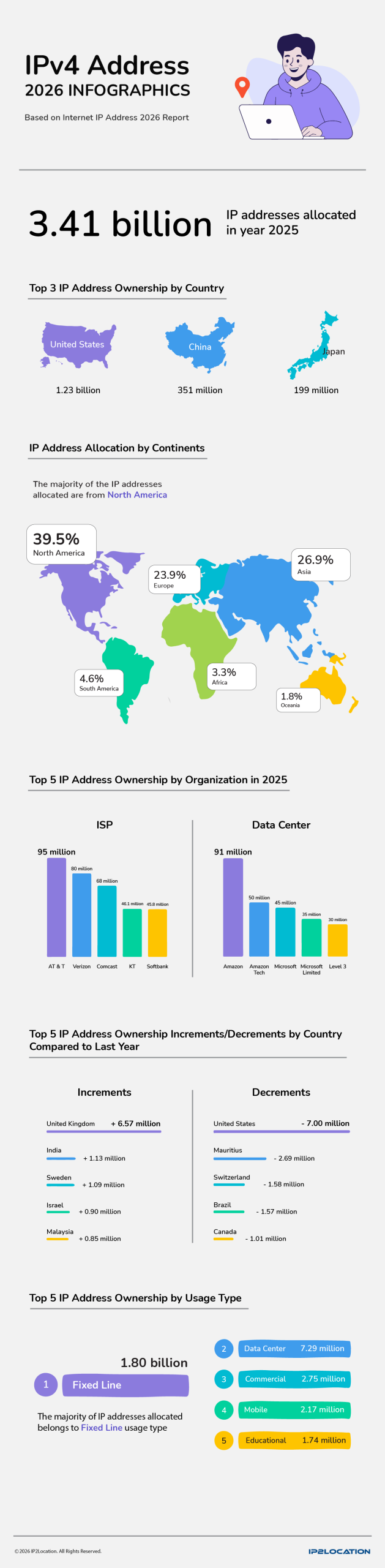
Based on the infographic, a total of 3.41 billion IPv4 addresses were allocated worldwide in 2025. In terms of country-level ownership, the United States remains the largest holder of IPv4 addresses with 1.23 billion addresses. China ranks second with 351 million addresses, followed by Japan with 199 million addresses. This distribution reflects early internet adoption and the presence of large technology and telecommunications companies in these countries.
Among all continents, North America continues to hold the largest share, which is 39.5% of global IPv4 allocations. This is followed by Asia with 26.9% and Europe with 23.9%, indicating a continued concentration of IPv4 resources in developed regions.
In the Internet Service Providers (ISP) category, AT&T leads with 95 million IP addresses, followed by Verizon and Comcast. For data centers, Amazon tops the list with 91 million IPv4 addresses, while Microsoft and Level 3 also hold substantial allocations, reflecting the ongoing growth of cloud computing services.
The infographic also highlights changes in IPv4 ownership compared to the previous year. The United Kingdom recorded the highest increase, gaining 6.57 million IPv4 addresses, followed by India, Sweden, Israel, and Malaysia. On the other hand, the United States experienced the largest decrease with a reduction of 7 million addresses, while Mauritius, Switzerland, Brazil, and Canada also saw declines. These changes may indicate IP reallocation, consolidation, or gradual migration toward IPv6.
When analyzing IPv4 allocation by usage type, Fixed Line networks dominate, accounting for 1.8 billion IPv4 addresses. This highlights the continued reliance on IPv4 for home and enterprise broadband connections. Other usage types include Data Centers, Commercial, Mobile, and Educational networks, each contributing a smaller portion of the total allocation.
Conclusion
Overall, North America, led by the United States, continues to dominate global IPv4 address ownership in 2025. Despite ongoing IPv6 adoption efforts, IPv4 remains widely used across fixed line networks, data centers, and commercial environments. The IPv4 Address 2026 infographics provide a clear overview of current allocation trends and can serve as a valuable reference for organizations and individuals looking to better manage or utilize IP address data in the future.
Internet IP Address 2026 Report
A report about IPv4 address allocations in 2025