
Atmospheric pressure is the force exerted by air molecules on a surface. It is caused by the weight of the air above us and is also known as air pressure or barometric pressure. Because gravity pulls air molecules toward Earth, the air becomes denser near the Earth’s surface. As a result, higher altitudes have thinner air and therefore lower pressure.
Atmospheric pressure is usually measured in the SI unit called Pascal (Pa). One Pascal is equal to one Newton per square metre (1 N/m²). In weather reports, a commonly used unit is the Hectopascal (hPa), where 1 hPa is equal to 100 Pascals.
Atmospheric pressure often changes due to several factors. The first factor is altitude—higher elevations result in lower pressure. The second factor is temperature; as warm air rises, the surrounding pressure decreases. The last factor is weather conditions. Cloudy, rainy, or unstable weather is typically associated with lower pressure, while clear and calm weather is usually linked to higher pressure.
Formula
To calculate atmospheric pressure, a scientific equation known as the Barometric Formula is used. The complete formula is shown below:
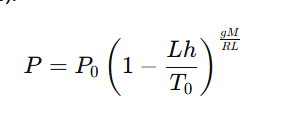
In this formula, P₀ represents the pressure at sea level, L represents the temperature lapse rate, h stands for altitude or elevation, T₀ is the standard temperature at sea level, and the term gM/RL includes gravitational acceleration, molar mass of dry air, the universal gas constant, and the temperature lapse rate respectively.
Atmospheric pressure affects our daily lives in many subtle but important ways. Weather forecasts rely heavily on pressure readings to predict storms, rain, or calm conditions, helping us plan our activities. Atmospheric pressure also influences how water boils, which is why cooking times can vary at high altitudes. Even common items like vacuum-sealed food containers, drinking through a straw, and the way our ears “pop” during elevation changes work because of differences in air pressure. Though we may not notice it, atmospheric pressure constantly shapes our environment and everyday experiences.
Conclusion
Atmospheric pressure plays a crucial role in understanding weather patterns, altitude effects, and the behaviour of air around us. Although it changes constantly due to temperature, elevation, and weather conditions, the concept itself is straightforward once we understand that pressure comes from the weight of the air above us. With tools like the barometric formula and standard units such as Pascals and Hectopascals, we can accurately measure and interpret these pressure changes. This makes atmospheric pressure essential not only in meteorology, but also in aviation, engineering, and many aspects of everyday life.